

-
About Qingfeng
-
-
-
Shandong Qingfeng | Laifuxing | Reasons for New Calf Laxin
Release time:
2021-11-05
American ADM company R & D and production, the only one into the Royal Medical Pharmacopoeia products Nano-coated emulsified high viable bacteria Probiotics temperature resistance, acid resistance, alkali resistance effectively improve the survival rate Effective control of diarrhea and pneumonia incidence Establish passive immunity and activate self-immunity Addressing Physiology and Intestinal Health MCT short carbon chain quickly replenishes energy to solve weak livestock. Reduce the use of antibiotics
calf diarrheaIt refers to the intestinal peristalsis, intestinal absorption is not complete or difficult to absorb, resulting in intestinal contents and a large amount of water is discharged from the body of a calf disease. Its clinical features are loose stool, soft stool or watery stool, vomiting, dehydration, weight loss and acidosis, and rapid death. So what is the cause of diarrhea in calves? How do you treat diarrhea in new calves?
Calf diarrhea focuses on prevention! Calves just born 6-12 hours recommended to take Fuxing probiotics, bacteriostatic bacteria, bacteria sterilization, bacteria quickly occupied, regulate intestinal health, prevent diarrhea, improve immunity, the effect of weak livestock.
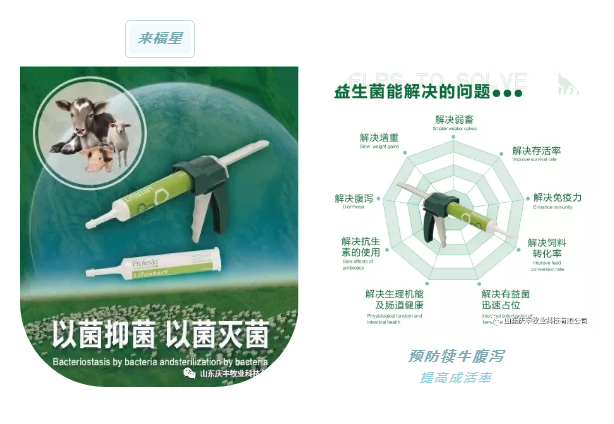
American ADM company R & D and production, the only one into the Royal Medical Pharmacopoeia products
Nano-coated emulsified high viable bacteria
Probiotics temperature resistance, acid resistance, alkali resistance
effectively improve the survival rate
Effective control of diarrhea and pneumonia incidence
Establish passive immunity and activate self-immunity
Addressing Physiology and Intestinal Health
MCT short carbon chain quickly replenishes energy to solve weak livestock.
Reduce the use of antibiotics
1. Environmental stress calves have not yet fully developed body structure and function after birth, especially the gastrointestinal digestive system. At this time, they are poorly adaptable to the environment and are more sensitive to noise and unfamiliar odors. In these cases, they often lead to digestive system disorders. Cause diarrhea. In the spring and autumn season, large temperature changes, poor environment and long-distance transportation will lead to stress response and diarrhea of calves.
2. The environment in which germs and viruses infect the pens is complicated, and germs and viruses are easy to grow and reproduce in this environment, while newly born calves have weak resistance. Coupled with climate change, they are extremely vulnerable to germs and viruses, causing loss of appetite, mental disorders, and diarrhea. In severe cases, calves will die.
3. Improper feeding of calves In the feeding process, if the feed is not fresh, or the feed is spoiled and moldy, it is easy to cause calves to have indigestion and diarrhea. Especially at the time of weaning, feeding feed during this period of time, the stomach failed to adapt to lead to diarrhea, illness after the discharge of water-like feces, the body emaciated.
4. Parasitic infection Coccidia infection mainly occurs in large-scale breeding grounds, resulting in a sharp increase in bacteria and microorganisms in the enclosure, which is extremely susceptible to parasites, such as common roundworms and nematodes. The specific realization of diarrhea, stool with blood, loss of appetite, dehydration and other symptoms.
Diarrhea caused by Escherichia coli is the most common symptom of acute enteritis. The stool is usually dry at the beginning and then thin, which is light yellow porridge-like and foul-smelling stool, followed by gray or watery stool, sometimes with foam, and then frequent defecation with fishy smell, some with rancid smell. Drainage like feces, often do not touch the tail hair, such as do not pay attention to the observation is easy to be ignored. The middle of the course of anal incontinence, often abdominal pain, body temperature increased to more than 40 degrees. In the later period, the body temperature dropped below normal temperature and became lethargic, with a mortality rate of about 10%. If bacterial blood dysentery occurs, the body temperature will rise, the pulse will be rapid, and the respiration will increase. Conjunctival flush or dark red, depressed spirit, appetite reduction or disuse, bowel hyperactivity, later more weakened, and some have abdominal pain. Due to severe diarrhea, diseased calves dehydrated and rapidly emaciated, sunken eye sockets, dry skin, decreased elasticity, decreased urination, blood concentration. If not timely rescue, can be in 1~3 days of death. Diarrhea caused by the virus often occurs suddenly and spreads rapidly. Newborn calves have gray-brown watery stools mixed with blood and mucus. Sick calves are extremely depressed and anorexia. After diarrhea, they restore their appetite and often relapse due to excessive intake. Calves infected with rotavirus mainly occurred within 1 month of age, the incubation period was 15h to 4d. The main symptoms were depression, anorexia, and dehydration diarrhea. The onset period can last 1 ~ 8d, the younger the age, the longer the onset time. Diarrhea caused by rotavirus can be cured within 24 hours without the synergistic effect of E. coli. If mixed with E. coli infection, the sick calf's body temperature will rise, white blood cells will decrease, and finally he will die of hemorrhagic enteritis caused by peptic ulcer, as well as local lymph nodes, collecting lymph nodes, spleen and thymus lymphatic tissue deficiency. The incubation period of coronavirus infection is 19~24h, and its clinical symptoms and intestinal lesions are more serious than those of rotavirus infection. Even if there is no coexistence of E. coli, diarrhea caused by coronavirus can kill calves over 1 week old. Cryptosporidium diarrhea, performance anorexia, progressive weight loss, a long course of disease, intermittent watery stool, occult blood in the stool, and contains mucus.
Diarrhea caused by improper feeding and management occurs mostly during lactation. At the beginning of the disease, it is mostly porridge and loose stool, pale yellow, grayish yellow and even grayish white. Later, some drainage-like dark yellow, sometimes yellow, sometimes porridge-like dark green feces, the smell is not big, if the condition is serious, there is a fishy smell. Feces are often attached around the anus, tail hair, hock joints and thallus. The temperature of the sick calf is generally normal, or slightly higher or lower. Pulse, breathing slightly faster, lack of energy, loss of appetite or waste, more like lying.
In addition, feces have a sour odor and are mixed with small air bubbles and undigested curd or feed fragments. The bowel sounds are high and there are mild dropsy and abdominal pain. Heart sound enhancement, heart beat speed, breathing speed. When persistent diarrhea persists, the skin is wrinkled and elastic due to lack of water in tissues and cells, and the hair is coarse and disorderly and loses luster, and the eyeball is sunken. In severe cases, he stands unsteadily and trembles all over. In the later stage of the disease, the body temperature dropped suddenly, the limbs, ear tips and nose were cold, and finally died of coma.
1, sulfamethoxazole treatment of diarrhea caused by bacteria, according to calves per kilogram of body weight 0.1 grams of oral, take 3 times a day, even take 3 days.
2. Florfenicol is injected intramuscularly at 0.01~0.02 grams per kilogram of calf body weight, 3 times a day for 3 days. When there is a virus infection, you can use isatis root injection, 20 ml/head.
3. When calves have appetite or can suck themselves, oral rehydration salts (3.5g sodium chloride, 1.5g potassium chloride, 2.5g sodium bicarbonate, 20g glucose and 1000 ml normal water) can be given to calves to drink freely. When self-sucking is not possible, 250 ml of 6% low molecular dextran, normal saline, 5% glucose, 5% sodium bicarbonate, 100 mg of hydrocortisone and 10 ml of vitamin C10 can be used. After miscibility, calves can be injected intravenously. In mild cases, fluid is rehydrated once a day, and in severe cases, fluid is rehydrated twice a day. Critically ill calves can also be treated with whole blood transfusion. Generally, cow blood from diseased calves can be selected and mixed with 50 ml of 2.5 sodium citrate and 450 ml of whole blood for intravenous injection.
4, oral 5~10 grams of bismuth subnitrate or 50~100 grams of clay or 10~20 grams of activated carbon, can also be enema discharge of toxic substances in the intestine. You can also use lactobacillus tablets 5~10 tablets, edible mother raw 5~10 tablets, mixed once oral, 2 times a day, for 2~3 days, the effect is good.
5. It can also be treated with traditional Chinese medicine: 20 grams of Pulsatilla chinensis, 20 grams of Banlangen, 15 grams of Coptis chinensis, 15 grams of Qinpi, 15 grams of Sanguisorba, 15 grams of ebony, 10 grams of Poria cocos, decocted, one dose a day, 3 doses. At the same time, but also pay attention to keep the cattle house clean, dry, timely removal of feces and dirt, and often disinfection, bedding dry bedding. Strengthen the feeding management of pregnant cows, feed ratio is appropriate, give enoughProtein, mineral and vitamin feedDo not make hungry or too full, to ensure that the cow has a good nutritional level, so that it can secrete sufficient milk after childbirth to meet the physiological needs of newborn calves.

Rocky Lick Brick Red RockyPhosphorus-rich RockyProgestational Rocky
Won the Sino-British double organic certification
Won the EU Green Free Sales Certificate
Queen's Award, the highest honor for British business
Improving the reproductive capacity of female animals
Prolonged peak lactation
Increase the hardness of the hoof shell
Prevention of pica
Prevention of afterbirth
Improve feed conversion rate
Improve health index
Regulating rumen acid-base balance
Prevention of heat and cold stress
Cow udders should be kept clean. When conditions permit, cows can be inoculated with E. coli vaccine one month before delivery; calves can eat colostrum as soon as possible after birth. At present, raising cattle is being vigorously promoted in the whole country, especially in poor areas. Its market efficiency stability factors and other reasons have attracted everyone to be very optimistic about the market prospects and the development of breeding scale. In fact, the season of raising cattle can be raised all the year round, and there are advantages and disadvantages. However, as long as we pay attention to the ventilation, safety and hygiene of the cattle barn, cattle will not get sick under normal circumstances, and their physique is much stronger than that of human beings. Now the general regular manufacturers are in accordance with the regular quarantine and epidemic prevention.
Share

Telephone:+86-0531-8712 3999 +86-151 6919 5199
Address of Marketing Department: Energy Saving Demonstration Building, Wolong Road, downtown Jinan City
Message feedback